

-
Dec 23 2019 
Happy Holidays
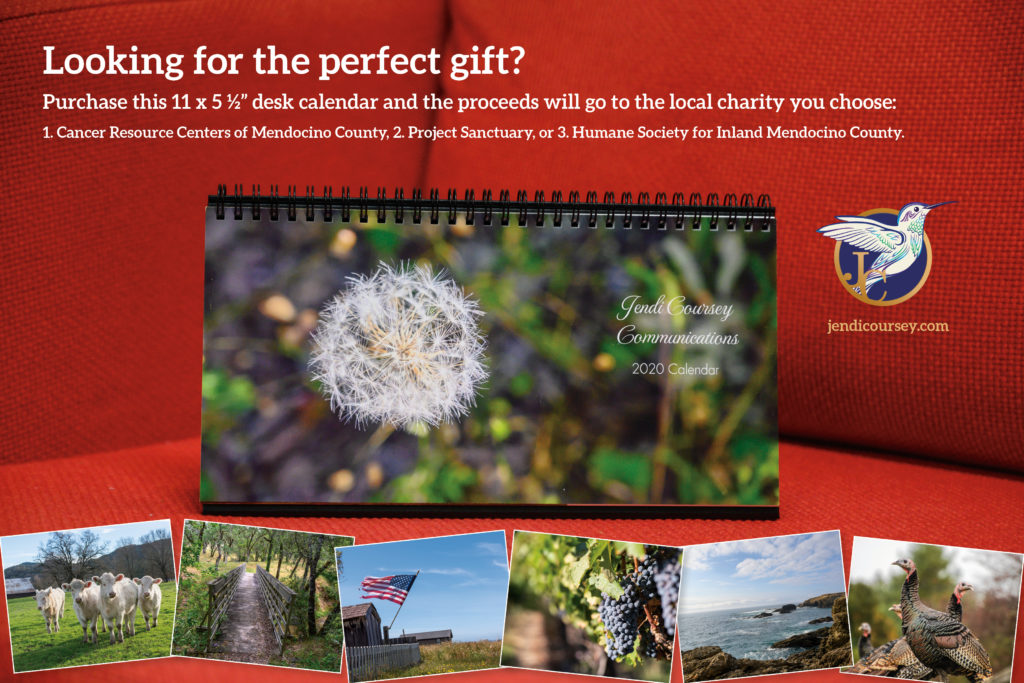
Looking for a last-minute gift-giving opportunity? We’re here to help! If you’d like to purchase a desk calendar featuring beautiful Mendocino County images for that special person on your list, send an email to kendyl@jendicoursey.com.
We will donate the entire $20 cost of the calendar to one of these local charities: 1. Cancer Resource Centers of Mendocino County, 2. Project Sanctuary, or 3. Humane Society for Inland Mendocino. Just let us know which one you’d prefer. We’re offering this charitable giving through the end of January.
We wish you peace, love, and health during this holiday season and always.
~Jendi & Kendyl
-
Nov 25 2019 
Consider Another Perspective

Years ago, I pitched an idea for a hospital marketing campaign to my boss and he rejected it immediately. He said it “didn’t resonate.” I was frustrated because I had done a fair amount of research and worked with a creative team to design unconventional messages that were amusing and engaging while still respecting the serious nature of health care.
As the president of the hospital, my boss thought his knowledge of health care would allow him to recognize how this campaign would land with the target audience, which was women between 35 and 55–the healthcare decision-makers in most families.
Rather than accept his rejection, I asked if I could share the campaign with his wife, a woman he trusted and a member of the target audience. She loved it and the campaign went ahead.
We all have a unique lens through which we see the world, a perspective that has been carefully cultivated through our upbringing and experiences. No matter how hard we try, most of us cannot really know how people outside our circle feel.
If communicating well with employees, customers, and other stakeholders is important to your work, consider doing a little field testing to see if your messages are on track. Also, rather than sharing information from your perspective (e.g., “I think xyz…” or “We provide a great product or service…”), consider how your message helps members of your audience reach their goals (e.g, “Let’s join together to make this happen.” or “Here’s how this product or service helps you do or be better.”)
I was recently listening to a podcast called TED Radio Hour on the topic of how to inspire people to action. It reminded me of the importance of sharing a vision and making it clear how that vision benefits the people you most want to reach. Using positive, concrete examples rather than vague ideas helps people see and feel the reality you describe. When they can see and feel it, they are in a better position to decide whether they want to join in.
If you want help developing messages that resonate, call us.
-
Oct 23 2019 
Overcoming Our Negativity Bias

The reason negativity exists in the workplace is because humans work there. Tens of thousands of years of evolution haven’t caught up with the comparatively short time we’ve been dealing with annoyances in the workplace as opposed to threats that could kill us. Luckily, our brains are malleable. We can create new neural pathways so our default responses don’t ruin potentially important relationships.
Our Caveman Genetics
Think back, if you will, to the Neanderthal days. Imagine you and your tribe are hanging out by the campfire when a member of a neighboring tribe comes over and starts nosing around. Those with a negativity bias quietly reach for their clubs while a welcoming young tribal member invites the stranger to join in. When the stranger bonks the welcomer on the head and runs off with his mate, the welcomer’s genes do not make it into future generations.
We are the descendants of the people who reached for their clubs.
Yay for Neuroplasticity
We are programmed to handle threats via our fight-or-flight response, whether those threats come from a club-wielding competitor or an out-of-line employee. The good news is that we can shift our negativity bias so it doesn’t get in our way, allowing us to move to the trust-but-verify crowd or even the assume-good-intentions crowd. We can reroute neural pathways in our brains by intentionally responding in a calmer, more controlled manner.
But first, we have to recognize we’re getting triggered and wrench control away from the amygdala (also known as the lizard brain).
Recognizing the Fight-or-Flight Response
Here are some sure-fire ways to know you’re in the middle of a fight-or-flight response.
- Your heart is beating like a trip hammer.
- You feel like you could lift a small car.
What’s actually happening is that your brain is flooded with the stress hormones adrenalin and cortisol. Your heart rate increases and your breathing becomes fast and shallow. Your muscles tense, your pupils dilate, and you get tunnel vision. Your digestive tract shuts down as blood rushes to your extremities, and access to the logical part of your brain practically disappears. This is great if you need to fight or flee, not so great if you need to manage a delicate negotiation with someone who is driving you crazy.
Grounding to Regain Control
How do you calm down? You begin grounding. Take slow deep breaths. I recommend “square breathing,” also called tactical breathing. Imagine yourself breathing into the corners of a box. First, take a deep breath and imagine all the air going into the upper left corner of a box. Hold your breath for four seconds. Then exhale slowly for four seconds as you imagine moving to the upper-right corner. Hold for four seconds. Then use another four-second inhale to move to the lower-right corner. Hold for four seconds, and exhale slowly to get to the lower-left corner. By the time you make it around the box, your heart will start to slow down.
Next, feel your feet on the ground–all ten toes–and go through an inventory of each major muscle group, tensing and relaxing each one as you go. Finally, focus on the information you can gather through your senses: what do you smell, taste, feel, and see? By the time you’ve done this, your prefrontal cortex (the thinking part of your brain) has begun to win the wrestling match with the amygdala
Getting Curious
Once your prefrontal cortex is calling the shots again, you can start asking questions to address the annoying behavior of a colleague or client. Ask yourself, “Does this really have anything to do with me or is this a symptom of a deeper issue—personal or professional? Is this person trying to be helpful, albeit ineffectively, or is this a ploy for attention? Where is the common ground here?”
Once you refocus on helpful questions, it’s amazing how the annoying behavior can change, at least your perception of it. If you realize a person is acting out of fear or insecurity, for example, you can put them at ease to help them communicate more effectively. If you remember that this person is dealing with a personal issue, you may give them a little grace, understanding they are not behaving as they normally would.
It’s also important to remember that people’s irritating behaviors can sometimes be a double-edged sword. We have to take the good with the bad. Here is a great video to illustrate the point.
Pro Tip: Start Meetings with a Check-in
If you are in a leadership position and regularly hold meetings, you may want to consider starting every meeting with a two-minute check-in using the following prompt: Is there anything you’d like to share about what’s going on for you this week, personally or professionally? It is amazing what people will share and how valuable this information can be to team dynamics.
If you think your staff could benefit from a little professional development in this area, get in touch. I’m happy to present a short, entertaining talk on the subject.
-
Sep 26 2019 
Knowing Your Audience

This is an excerpt from a guest lecture I gave to budding filmmakers and storytellers in Kirk Fuller’s Introduction to Video Production class at Mendocino College on September 21, 2019.
When we are born, we are all fitted with an invisible pair of glasses. As babies, there is no glass in the frames, but almost immediately, life starts putting in different lenses. We get the lenses of our family’s values, the lenses of the various experiences of our upbringing, the lenses of social norms, the lenses of pivotal moments in our lives, personal and those shared by our whole generation. By the time we reach adolescence, we are all walking around with Coke-bottle lenses that distort the world in a very particular way.
So it’s no wonder that we sometimes have trouble communicating with one another. While we try to describe the world right in front of us—the same world in front of our audience—we see it very differently.
Walking Next to Someone Isn’t the Same as Walking in Their Shoes
I was recently listening to City Arts and Lectures story on National Public Radio featuring James Forman, Jr., who worked as a public defender with many clients from terribly traumatic backgrounds full of violence and poverty, often young men raised by parents who were abusive, addicted to drugs, and intermittently incarcerated. Forman told a story of how he came up with ideas while walking to work and recommended the same practice to a client. The client responded, in essence, “When I’m walking along in my neighborhood, I’m just trying not to get jumped.” These men could have been walking down the very same street. Forman made the point that while he was walking alongside his clients, he was not in their world. He wasn’t looking through their lenses.
The Lens We Use to See the World is Skewed by Our Generation
While an innumerable number of variables makes up each person’s lens, there are commonalities by generation and by circumstance that bring us together. Generational lenses are powerful because people share both their current stage of life as well as common social influences, having grown up during the same era. Circumstantial lenses are powerful because, regardless of age and stage, people who are faced with a similar dilemma or opportunity can find common ground. For example, parents have a similar desire to do what’s best for their children, and cancer patients have a similar challenge in navigating a broken healthcare system.
Probably one of the most important things to remember as we think about knowing our audience is that our audience is human, and humans make decisions based on emotion. It’s fine to provide facts, but recognize that we use those facts to fabricate the stories we tell ourselves, and it is our emotional investment in those stories that cause us to act (or not).
Any time I begin working with a new client, I ask two questions: who do you want to reach and what do you want them to do as a result? These two questions inform every subsequent decision.
We All Have Blinders On — the Trick is Learning to Get Past Them
As we contemplate the who-do-you-want-to-reach question, it can be challenging to answer fully, because when we look through our own lenses, there are audiences we don’t see. It is incumbent upon us all to look for people at the edges of our lenses and then to enlist their help to reach people at the edges of their lenses, and so on until we’ve truly and fully defined whom we want to reach.
During the U.S. Presidential campaign in 2012, Hillary Clinton supporters wore pink pussy hats to protest then-candidate Donald Trump’s treatment of women. Those who designed the hats left out large numbers of allies when then made the hats pink. Caucasian women have pink skin. People of color do not. That was a major missed opportunity. Instead of coming together as women, which would have been a larger and more powerful alliance, they came together as white women.
Not only do we need to look at the edge of our lenses and seek out audiences who do not share our backgrounds, if we are to be effective storytellers, we must also understand the values of people at the edges of our familiar zone and beyond. This is definitely an area where generational differences are often in play.
Baby Boomers
The values of each generation are rarely mutually exclusive, but they are different. The Baby Boomers (born 1946-’64) generally believe the following: anything is possible; equal rights and equal opportunities matter; Boomers are extremely loyal to their children; they are optimistic and involved; they value personal gratification and personal growth; they question everything; and their financial motto is, “Spend now, worry later.”
Gen X
Generation X (born 1965-’80) sings a different tune. They believe in thinking globally and acting locally. They value diversity. They are self-reliant (having been latch-key kids), entrepreneurial, and pragmatic. They seek a work-life balance, and as a group, they are highly educated. They and the generations before them value duty, family, and integrity above social justice and authenticity.
Millennials
Millennials (born 1981-1995) are a huge generation–about 95 million strong–and the first to be technologically fluent, having grown up in the era of personal computing. They value authenticity, happiness, diversity, sharing, and discovery. They want corporations and other organizations to put their money where their mouth is and are loyal to brands that align with their values.
Gen Z
Generation Z (born 1996-2019) includes the up-and-comers. These folks are young and idealistic, but also put their ideals into action. One trend that differentiates Gen Zers from Millennials is how they define gender and beauty – both are more fluid. Gen Z is also more comfortable talking about mental health and they are all about instant gratification, which often comes in the form of convenience. Gen Z is values-based and action-oriented. Be aware that they have short attention spans, so if you want their attention, you have to make it worth their while quickly or they’ll move on.
Emotional Connection
So, as we try to answer the questions of who do you want to reach and what do you want them to do as a result, consider using a values-based approach. Tell a story that matters. If I am your audience, show me how you can help me align my actions with my values by joining with you and I will be yours forever. Regardless of who you’re talking to, remember we are all connected by universal human truths. We all want to belong, to be accepted, to feel safe and to feel an affinity for those aligned with our values.
-
Aug 26 2019 
Letting Your Inner Control Freak Rest

Many of us prefer to complete projects on our own rather than accepting help from others or delegating part of the work, even if it means sleepless nights or sacrificing personal time. We may be tired and sometimes resentful of the time it takes to get the job done right, but we are damn sure not going to let someone else screw it up. Allowing others to work on our projects can feel like allowing a crack in the dam, and we all know cracks can be a dam’s undoing.
If you’re nodding your head in agreement, I sympathize. I have perfectionistic tendencies and while they can contribute to high-quality outcomes, sometimes the price is too high.
I was recently talking to the leader of a successful company and he said, “Good leadership means explaining what you want, making sure the employee has the resources and training to get the job done, and then getting out of the way.”
“Good leadership means explaining what you want, making sure the employee has the resources and training to get the job done, and then getting out of the way.”
The last part is the hardest and the most important.
If you want to build a team, you’re going to have to let go a little. There’s no getting around it. This doesn’t mean throwing out your high standards and putting your reputation on the chopping block. It does mean stepping back a little.
People will make mistakes. It’s inevitable. But here are some steps to build strong teams and encourage them to do their best work.
Hire the right people.
Start with good people. A thorough vetting process is key. Hiring out of desperation rarely ends well. Better to have everyone be overworked for a short time than to rush into hiring a bad apple. In addition to job skills, check for alignment with values and work ethic. If your company culture has everyone arriving promptly at 8:00 am, let new hires know timeliness isn’t optional.
Communicate expectations.
Once you’ve got the right people on board, it’s all about clear expectations. If you have a high-functioning team, it’s worth sharing more than just budget constraints, deadlines, and work specifications. Explain the big picture. What problem are you solving? Is this the best way to do so? One of the benefits of having team members is the synergy of multiple points of view.
One of the benefits of having team members is the synergy of multiple points of view.
Check in but don’t hover.
Once a project is in motion, make course corrections periodically and then back off again. Empower people to make their own decisions as much as possible. When giving feedback, look at the overall progress before diving into the details. And above all, resist the temptation to take back delegated work before it is finished if you find a small mistake.
After it’s all done, review the results and the process.
Start with the positive. Then ask open-ended questions like these:
- Which decisions, if any, would you make differently next time?
- Let’s review the original goals/specs. Did we meet them? Why/Why not?
- Did we have the information we needed from the client? Is there anything more we should collect next time?
Reviewing a project’s successes and failures in a collaborative atmosphere can help everyone improve. Just be sure to set the ground rules first so people understand the goal is to learn, not to blame others for any mistakes.
If you naturally lean toward being a micromanager, just remember that believing in people helps them believe in themselves–and confidence helps people perform to their highest potential.
-
Jul 30 2019 
When E.F. Hutton Talks, People Listen — How to Build a Solid Reputation

Years ago, there was an advertising campaign by the brokerage firm E.F. Hutton. It went like this. Two guys were discussing their stock portfolios. One would say, “My broker says this is a good buy.” And the other would say, “Well, my broker is E.F. Hutton, and E.F. Hutton says…” At this point, the camera would pan out to show that everyone in the room/on the airplane/in the restaurant/on the golf course had stopped what they were doing to hear what E.F. Hutton had to say. It was corny and repetitive, but also entertaining and effective.
Clearly, the ads imply that E.F. Hutton gave great advice. The question is, how did he earn his reputation? Asked another way? How did he build trust and respect? Here are a few ways to become like E.F. Hutton.
Get it right. Do your homework. Verify information. Proofread your writing. Give yourself enough time to ruminate on ideas so you can make the strongest possible arguments. Have others check your work.
Be consistent. Nothing builds trust as well as consistency. Let people know what they can expect from you and deliver it every time, rain or shine. Think about people you know well. What quality or trait defines them? What would you like your company to be known for? Pick a few qualities or traits for your business and make sure everyone in the organization knows they are non-negotiable.
Don’t over-promise. Most folks have heard the old adage, “It’s best to under-promise and over-deliver.” And yet, people over-promise all the time. If you promise to deliver something by Friday and it doesn’t arrive until Monday, you’ve proven you aren’t trustworthy. If you promise the delivery by Monday and deliver on Friday, you will be the first one called next time they need timely service. Set expectations; then jump out of your shoes to surpass them.
Admit and fix mistakes. As a public relations consultant, I often get push-back on this one, especially when lawyers are involved. But I have to say, it’s a rare situation where a heartfelt apology and making amends didn’t work wonders.
So, if you want to be like E.F. Hutton and have people listen, you’ll need to do what it takes to get things right, be consistent, deliver on your promises and fix your mistakes. (It also helps to have a fabulous advertising company.)
-
Jun 25 2019 
Why “Compromise” Isn’t a Dirty Word

As politicians reach for the outer edges of their respective parties, the ones who compromise are being labeled as sell-outs rather than pragmatists, leaving those of us in the political center without much hope for reasonable leadership. And it isn’t just in politics, the art of compromise seems to be disappearing in boardrooms, town halls, and among everyday Americans. Not cool.
We’ve always had leaders who hold firm to an ideal, and I recognize that those folks can serve an important purpose: setting a standard, providing a visionary goal. But when two opposing sides entrench, we go nowhere. It baffles me that so many people consider “uncompromising” a compliment when synonyms include words like rigid, obstinant, intransigent, stubborn, and pig-headed. Are these the traits we admire? I sure don’t.
The intense political polarization in our country is tearing us apart, which is heartbreaking because I really believe so many more people are in the center than on the fringes. But when the political discourse is dominated by fringe elements, we all begin looking at our neighbors with a bit more suspicion. I guess by pandering to the people on the outermost edges of political ideas, politicians and others hope to engage those who are more passionate; that is, more apt to act (donate, volunteer, attend a rally) than those of us in the center.
As Americans, we have so much more that unites us than divides us. I live in a small town where I have friends of all political stripes, from libertarians to liberals to conservatives. Mostly, we all want to provide for our families and to be allowed to live our lives according to our own values.
As Americans, we have so much more that unites us than divides us.
As a public relations professional, I help clients develop and share their messages with the goal of convincing others to join their cause, to align with their way of thinking enough to support whatever they’re promoting, whether it’s ideas, products or services. To develop effective messaging, I spend a fair amount of time trying to understand what motivates various audiences, and what I find is that there is a tremendous amount of common ground to play with.
Unfortunately, just because I can find common ground doesn’t mean it’s easy to compromise. It’s often hard to know when to compromise, how much to compromise, and with whom to compromise. Giving away ground on a position requires trust, and that’s hard to come by in this polarized environment. I guess I would say this: if you’re in an argument where both sides stick to the issues rather than degrading into a mud-slinging contest, maybe someone could be brave enough to suggest a way forward that gives each side a little of what they want. And when we find ourselves being hijacked by emotion, we need to recognize it in ourselves.
As the 2020 political campaigns ramp up, I hope those of us in the center will be willing to speak up to support a more pragmatic approach, one that includes a little compromise. I think we need to publicly applaud leaders who work with counterparts across the aisle to make America a prosperous nation where people of all descriptions can work hard to achieve success.
-
May 30 2019 
Get Your Press Release Published
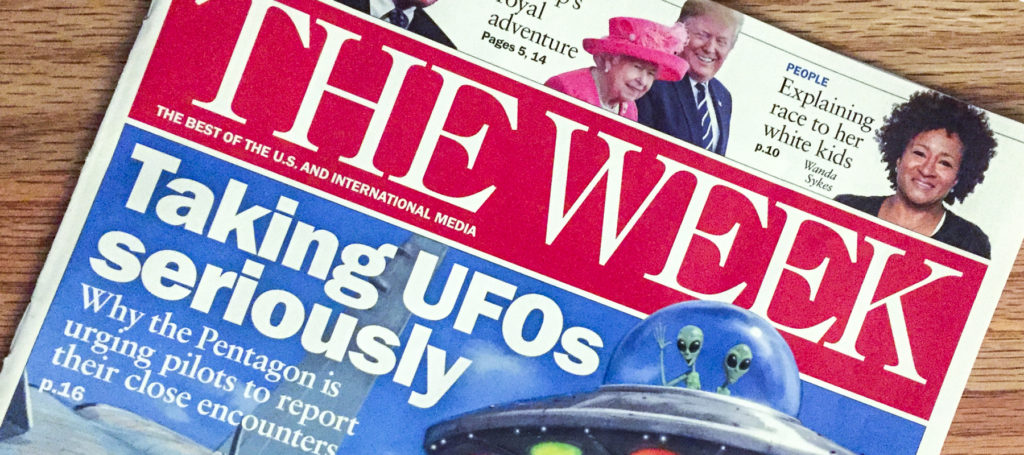
Every week, I read a magazine called The Week. It’s a fairly balanced summary of the week’s news. I read it in order of my favorite sections: Good Week/Bad Week, It Must Be True I Read It In the Tabloids, It Wasn’t All Bad, and of course, the summary of American and international news and politics. Usually, there’s a little section called Boring But Important, where essential but often technical or dull information is shared. Today, my column falls under this category; it’s boring but important. So many people don’t know how to write a decent press release, so they don’t get the media coverage they deserve. Learning what makes a press release newsworthy isn’t the sexiest topic, but it really is essential if you want to grab the attention of the news media. The elements that make a press release newsworthy are these:
- timeliness,
- significance,
- proximity,
- prominence, and/or
- human interest.
Timeliness
One of the first questions journalists will ask themselves when they read a press release is, “Why is this important right now?” If the answer isn’t obvious, your press release has failed the timeliness test. Connecting your news to something that’s hot or trending can increase its chance of getting published. Can your topic be tied to an upcoming event? How about to a national recognition month or commemorative anniversary?
Significance
Significance sometimes trips people up. All too often, they confuse big news inside their organization with something that should get printed in the local paper–for example, when a top executive either leaves or joins an organization. Unless that executive works for a Fortune 500 company (or one of the biggest employers in the community), their arrival or departure is not significant from a community standpoint. It’s fine to share information about executive turnover in the employee newsletter, or even with customers, vendors, and partners, on your website and in social media, but it doesn’t meet the threshold for the news media.
If you’re trying to figure out whether your news is significant, consider its impact on your audience–the people who read the newspaper. Oftentimes, if your story is odd or unusual, or includes conflict or scandal, it is more likely to run.
Proximity
Proximity, either geographic or by affiliation, can make news feel more relatable and relevant. A rash of burglaries in a small town in another state is unfortunate, but not particularly newsworthy in your town. A rash of burglaries in your neighborhood, on the other hand, would certainly grab your attention (and therefore, the attention of your local paper).
Prominence
If your story involves famous people, elected officials, or local opinion leaders, it’s more likely to pique the interest of journalists. In my town, we have a very popular sheriff. If he endorses a cause, people are far more likely to support it. So, a good way to get local press is to mention that your event or cause has the support of Sheriff Allman.
Human Interest
An appeal to emotion or to the way we are all interconnected is often a great way to get press. Of course, this is subjective. Again, be sure to write to your audience. If you are writing to the weekly pet journal and you share a harrowing story of how your puppy escaped a fenced yard and was chased by coyotes only to be saved by the local mailman, you’ll likely get published. That same story probably won’t get published in the local business journal. Remember, if you have some of the other newsworthy elements and a human interest angle, you’re more likely to get published.
If you need help with the nuts and bolts of how to write a press release, click here. If you’d rather just hire someone to write your press releases, hire a publicist!
-
Apr 16 2019 
Hire a Freelance Writer to Help You Strut Your Stuff: Community Benefit Reports

If your organization is a non-profit or a B-Corp, then every year or so you need to write a report that demonstrates how you’ve contributed to making the world a better place. Hiring a freelance writer to write this report can benefit you in two ways. First, you get an objective outsider who can write for a broad audience, helping to translate industry-speak when appropriate and making your key findings easy to understand. Second, you don’t have to write the report yourself!
Who to Hire
If you’re going to hire someone outside your organization to write your annual report, impact report or community benefit report, consider the following:
- Is their writing compelling and easy to read? (Don’t take their word for it–ask for samples of their work or client references.)
- Have they done this type of writing before?
- Can they take a large volume of information and distill it to its essence?
- Are they easy to work with?
- Can they meet a deadline?
- Can you afford them?
A good writer will help you create a report that does more than simply meet a regulatory requirement. Since you have to write the report anyway, why not create one that inspires donors, shareholders, board members, constituents and any other key audiences you want to reach?
The secret to any good report is a compelling narrative. You can (and should) use facts and figures to help tell the story, but please, for the love of God, tell an interesting story.
How to Hire Them
If you’ve never hired a freelancer to write a report, here’s how it’s done:
- Give a brief overview of the project (share past reports or
examples from others in the industry if you have them). How will this information be shared? Online? Print? Both? Do you need a slide deck and a narrative? - Explain any regulatory requirements.
- Determine the scope of the project: define who will provide what information to whom and when. Is the writer doing any research or will all relevant material be provided?
- Is the writer responsible for working with a graphic designer to provide the finished product or are you hiring the designer?
- Establish the timeline. Is there a regulatory deadline? Do you want printed copies in hand for a conference or annual meeting? Work
backward from there to determine milestones and progress reports. - Agree to a budget.
When to Hire Them
Like many things, writing is best done without the proverbial gun to one’s head. If you are a non-profit hospital, for example, you know you have to publish a community benefit report every three years. Don’t wait until the month before it’s due to
hire a writer.The Whole Shebang
When I write this type of report for clients, I like to offer a comprehensive package, which includes interviews and research, writing, photography, data analysis, and graphic design. I love to meet in advance and plan periodic photoshoots for big events, get quotes from VIPs when it’s convenient for them, and capture data when it’s fresh and available. If this sounds like a far easier process than the one you’re currently using, let’s talk. Maybe I can help.
-
Mar 29 2019 
Designing Reports So People Want To Read Them

In this era of sound bites and social media posts, people aren’t used to slogging through long reports. Unfortunately, information doesn’t always fit in a tweet. If you must present a multi-page report, help your audience by using the following elements:
- Table of contents (for reports longer than 10 pages long)
- Executive summary (for reports longer than 10 pages)
- Plenty of white space (i.e., margins and space between and around paragraphs and infographics)
- Headers to signpost important topics
- Bulleted lists
- Infographics and other non-text means to convey your messages
- Engaging photos
- Page numbers
I recently wrote a 20-page report for a client, detailing the findings from my research and recommending several courses of action. I wrote the report in Microsoft Word with plenty of section headers and bulleted lists to make it readable, but as I was proofreading it, I found myself wanting to skip over some of the longest sections. If I wanted to skip them, I knew my client would, too.
If you run into this problem and you have the budget to hire a professional graphic designer, then send your report to the designer without delay. If you don’t have the funds (or time) for a designer, consider using a pre-designed template (Microsoft offers lots of them). Your final report may end up a few pages longer, but your readers will thank you for presenting the information so they can digest it.
For my report, I added a cover page with an engaging title, a byline, and a photo that invited a second look. I created a table of contents to make it easier to find information. I added an executive summary so people in a hurry could absorb the main points quickly. And I used a template (and my graphic design experience) to highlight the information that mattered most.
The great thing about hiring a professional graphic designer is that they know how to typeset reports so people can fly through the information effortlessly. Designers know how to use layouts, color, fonts, images and infographics to draw attention to the most important issues. A well-designed report won’t look designed; it’ll simply come across as professional, well-organized, and easy to read.
If you need help writing a report, get in touch. If it’s a long one, I’ll have my graphic designer buddies lay it out for us.
Jendi Coursey
